
Valence People keeps everything about your people in one place, from the day someone accepts an offer to the day they collect their last payslip. New starters have their accounts and their laptop on day one, leavers lose access on their last day, and every policy, form and approval follows your rules rather than ours.
In development
Valence People is in development and cannot be bought yet. Everything described on this page is planned functionality rather than working software. The interactive prototype demonstrates that planned functionality using fictional data and invented people. For release timelines or to join the pilot, tell us what you need.
What it does
Everything in this section describes how Valence People is designed to work, not what it does today. Most HR systems hold the records and leave the hard parts to spreadsheets and email, and this is designed around the hard parts.
Leave that adds up
Balances are worked out on each person's own working pattern, including half days and part time hours, so nobody's figure needs checking by hand.
Absence that is not leave
Sickness is reported, often by a manager, stays open until the person is back, and needs no approval. Return to work conversations are prompted.
Joiners and leavers as a process
Accounts, groups, equipment and manual tasks are created from rules for each role and office, and removed in the right order when someone leaves.
Approvals that never stall
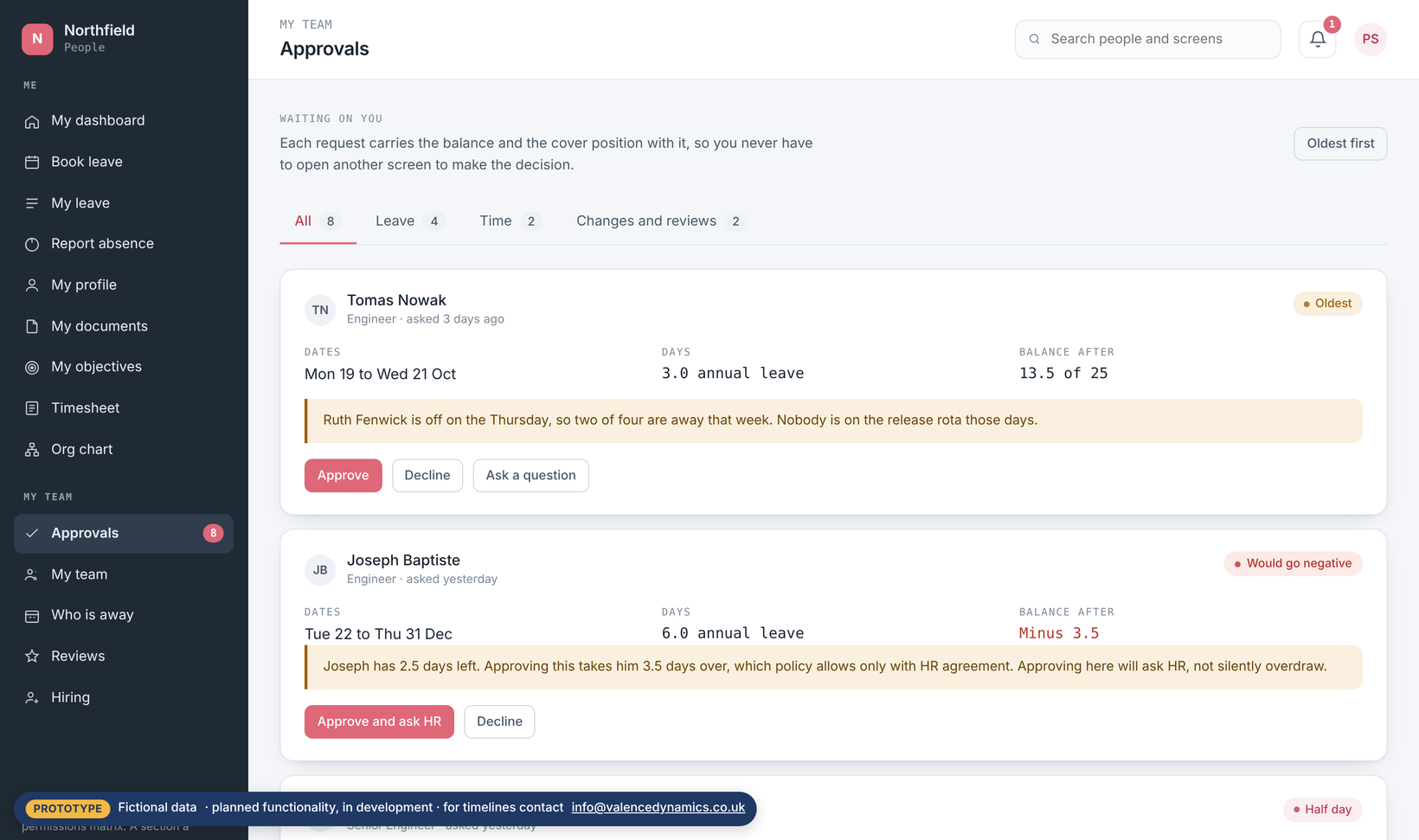
When someone is away or has left, their requests move on to a person who can decide. Nobody has to remember to set up a delegate before their holiday.
A history you can trust
Every change records when it took effect and when it was entered, so you can see your organisation exactly as it stood on any past date.
Configuration, not code
Offices, roles, leave policies, approval chains, forms and the words on screen are settings, not change requests, and you change them yourself.
What each person gets
Your people
- Book leave in seconds, with the real balance updating as they pick dates and bank holidays already allowed for.
- Report an absence from a phone, in one step. Colleagues see only that someone is away, never why.
- Change contact details straight away. Address and bank changes are checked first, and they can see where a change has got to.
- Payslips, letters, contracts, policies to read and training due, in one place, and payslips stay available after they leave.
- Resign without an awkward email: notice period and holiday owed are shown first, and it goes privately to their manager and HR.
Your managers
- One inbox for leave, timesheets, overtime, flexible working and access reviews, each with the balance and the cover position attached.
- A team calendar that flags the days the team would be too thin before you approve, rather than on the morning it happens.
- New starters ready on day one: what is done, what is waiting on you, the first week plan and probation objectives.
- Objectives visible all year and check ins recorded, so a review still holds together when someone changes manager mid year.
And for HR, one inbox for everything that needs an HR decision: resignations to confirm, changes to approve, documents to check and dates coming up. Absence triggers are applied by rule, cases are visible only to the people named on them, and leave year end is previewed months ahead rather than discovered in January.
Works with the systems you already run
It sits alongside the tools you have rather than replacing them.
What connects
- A new starter's identity, mailbox, groups and licences, created from rules for their role and office, then checked, and removed when they leave.
- Your time tracking tool stays where it is. Hours come across automatically, and approving in either place updates the other.
- Payroll gets a monthly change file with a cut off. Late changes are flagged as retrospective rather than missed or paid twice.
What does not
- A system with no API becomes a tracked task with a named owner and a deadline, so nothing rests on somebody remembering.
- So does the laptop, the door pass and everything else that is a person doing something rather than an API call.
How we compare
You will probably also look at BambooHR, HiBob, Personio or Breathe. They are good products, and each one suits a particular kind of organisation.
| Product | Good fit for | Where we differ |
|---|---|---|
| BambooHR | US companies. Core HR, with payroll and benefits add ons built for the US. | Designed for organisations with offices in more than one country, rather than around one country's payroll and benefits. |
| HiBob | Mid size international companies. A polished people platform, priced by quote, with optional modules. | We intend one price with every module included, rather than a core platform with modules charged on top. Pricing is not set. |
| Personio | European small and mid size businesses. HR, recruiting and workflows together. | We are designing joiners and leavers to include the laptop and the systems with no API, each one tracked to done. |
| Breathe | UK small businesses. Simple and low cost, with plans up to 200 people. | Built for several offices, where approvals and history have to keep up with growth. |
Based on each vendor's public information, checked in October 2026. Products change, so check the details with them before you decide. BambooHR, HiBob, Personio and Breathe are trademarks of their owners.
Against a typical hosted HR system
| Typical hosted HR system | Valence People | |
|---|---|---|
| Where your data lives | The vendor's cloud | Our cloud. UK or EEA hosting is the intended approach, with the location and the controls separating one organisation's data from another confirmed before a pilot |
| How it looks | The vendor's product with your logo on it | Your colours, logo and wording throughout |
| New starter accounts | Usually through your identity provider, or an add on connector | Built in, with the laptop and the manual tasks in the same checklist |
| Systems with no API | Left to email and memory | A tracked task with a named owner and a deadline |
| Approver away or left | Often waits until somebody sets up a delegate | Moves on to someone who can decide |
| Your organisation on a past date | Partly, through job and pay history | All of it, as it stood on the date |
Still on spreadsheets and email?
They work until the person who understands them is on holiday.
| Spreadsheets and email | Valence People | |
|---|---|---|
| Leave balances for part timers | Worked out by hand | Calculated from each person's working pattern |
| A new starter's accounts and laptop | Chased by email | Created from rules, and tracked to done |
| A leaver's access | Removed when somebody remembers | Removed on their last day, and checked |
| Who changed what | Nobody knows | Every change recorded, with before and after |
| Approver on holiday | The request waits | It moves on automatically |
| Year end holiday | A surprise in January | Previewed in November |
| The organisation last March | Lost | Shown as it stood on the date |
Your people's data stays private
HR data is the most sensitive data most organisations hold. These are the access controls Valence People is being designed around, and they are requirements for the build rather than controls you can audit today.
Who can see what
- Salaries, bank details and health information are designed never to be sent to somebody who should not have them, rather than sent and then hidden on screen. Demonstrating that is a requirement before production.
- Grievances and disciplinaries are designed to be visible only to the people named on the case, which can exclude HR colleagues when the case concerns them. That rule is part of the permission model still to be built and tested.
- Append only logging of every change, and of every view of sensitive data, is a design control we intend to build. It will be implemented and independently verified before any production use, and we will show you the evidence rather than ask you to take it on trust.
Where it lives
- Hosting in the United Kingdom or the European Economic Area is the intended approach, with the location and the data isolation controls confirmed before a pilot. You remain the controller and we are your processor, acting on your instructions under the data protection agreement we sign with you, under the UK and EU GDPR.
- Bank changes are applied only after a call to a number already on file, because changing bank details is the commonest payroll fraud there is.
- We intend to provide an export of your data in a documented format. What it contains and when it can be run are to be agreed with you and tested before any live pilot, rather than promised here.
How Valence Dynamics handles personal data as a company is in our privacy notice and terms of use.
Up and running in three steps
Most of the setup comes out of spreadsheets you already have.
1. We set it up
Your offices, roles, leave policies and approval rules, checked against a preview before anything goes live.
2. Your systems connect
Identity, payroll and time tracking, tested end to end with a sample joiner and a sample leaver.
3. Your people sign in
With the login they already use. New starters get a secure link before their first day.
Questions you might have
If yours is not here, ask us.
Will it work with our identity provider?
That is the design: any provider supporting standard provisioning or directory protocols, with anything else added as a connector rather than a change to the product. No connector is built yet.
Do we have to change our payroll?
No. The design is that your payroll provider carries on running pay and receives a file of changes from us each month. That integration is not built yet.
Can we keep our time tracking tool?
That is the intention: you keep the tool, hours come across, and overtime is picked up for people to claim. The integration is not built yet.
Is Valence People available now?
Not yet. It is in development, and the prototype shows how it will work using sample data. For release timelines or to join the pilot, get in touch.
How long does setup take?
Most of it is loading the offices, roles and policies you already have, so it depends on how many of each you have. We have not run a setup for anybody yet, so treat any timescale we give you as an estimate until we have.
Can it handle more than one country?
Each office can have its own working patterns, holiday calendar and approval rules. We are not claiming to maintain any country's statutory minimums for you: which countries we will support, and who keeps those rules current, is not decided yet.
Who can see salaries?
The design is that only HR and Finance see them by default, and that you decide who sees what, field by field. The permission model is not built and tested yet, and it is one of the things we would expect you to check before a pilot.
What happens when an approver is away?
The design is that the request moves on to their manager or a delegate by itself, using the system's own leave and absence records, so nobody has to set up a delegate before a holiday. You can see it in the prototype. It is not built.
Can we get our data out?
That is what we intend to provide, in a documented format. It is not built yet, and its contents and availability will be agreed with you and tested before a live pilot.
Where will our data be held?
Nowhere yet, because there is no production system holding anybody's data. The intention is the United Kingdom or the European Economic Area, and we will confirm the location in writing before a pilot rather than leave you to take it from a web page.
Will Valence People be GDPR compliant?
It is being designed for the UK and EU GDPR, and there is no production system to assess yet. When there is, you will be the controller and we will be your processor, acting on your instructions under a data protection agreement we sign with you. Compliance is shared either way: the law also covers what you collect and why, and that stays your decision.
Does it work on phones?
Booking leave, reporting absence, approvals and timesheets are designed for a phone first, and the prototype runs on one, which is the part you can check today.
Can people use it before their first day?
That is the design: a secure link to their personal email, with no company account needed. Not built yet.
Can we use our own branding?
Colours, logo and the words on screen are settings rather than a build. The prototype has the switcher in it, so this is one you can try rather than take on trust.
The pilot, and what it costs
Valence People is in development, and we are taking on a small number of organisations for a pilot, in phases. A pilot runs on your own offices and policies rather than a demo company, with no card details and no long term commitment, and you can start with one team or one office. If you decide not to continue, what happens to your data is settled in the pilot agreement before the pilot starts: the export you receive, the deletion we carry out, how long it persists in backups, and anything we are required by law to keep.
Pricing is not set. The intention is one price per employee per month rather than a core platform with modules charged on top, with nothing to pay for managers, leavers, or people before their start date, and the figure agreed after your pilot. Nothing here is a quote.